
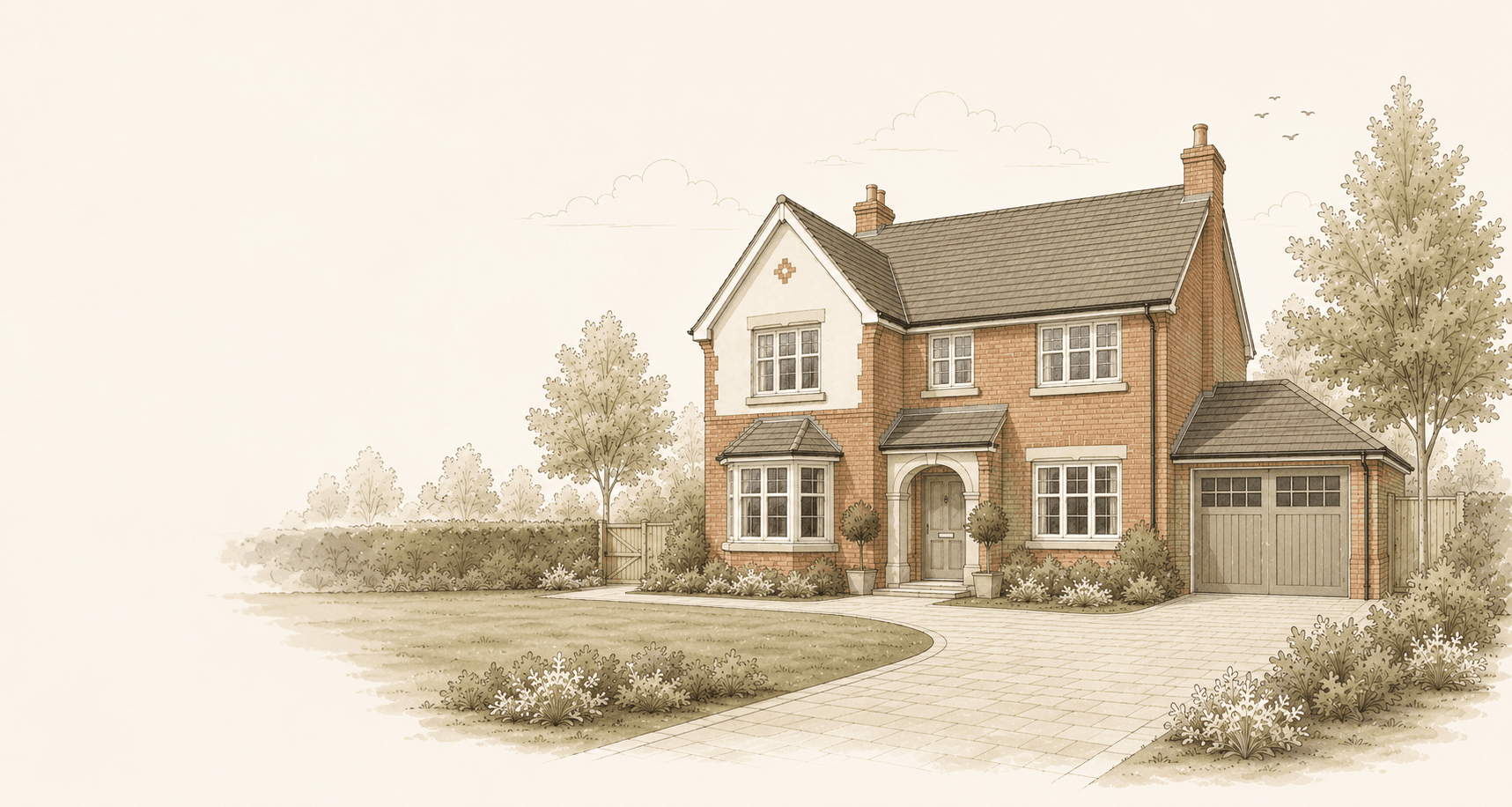
The number of children does not decide the use class by itself
Class C2 covers residential accommodation and care for people in need of care. Class C3 covers dwellinghouses and can include up to six residents living together as a single household where care is provided. The difficult issue is often whether a small children’s home would still have the character of a dwellinghouse or whether its staffing and operational arrangements make it materially different.
There is no special planning-law exemption that says “one or two children equals C3”. Equally, there is no rule that every one- or two-child home must make a full C3-to-C2 planning application.
The statutory starting point is the Town and Country Planning (Use Classes) Order.
North East decisions show why there is no one-size-fits-all answer
Local examples are useful because they show that small children’s homes are dealt with under different planning routes depending on the proposal.
At 41 Sandmoor Road, New Marske, Redcar and Cleveland Borough Council granted full planning permission in December 2024 for a C3-to-C2 children’s home restricted to a solo placement. The submitted model involved one child, up to three staff during the day and two staff sleeping overnight.
In September 2026 the same authority granted consent at 3 Sheerness Way, Redcar for a children’s residential home for a maximum of two children.
These decisions do not mean every one- or two-child home in the North East needs full C2 permission. They do demonstrate that a low occupancy figure does not, by itself, remove the planning question.
See the official Redcar and Cleveland records for 41 Sandmoor Road and 3 Sheerness Way.
Can a two-child home operate without a material change of use?
Potentially, yes. The planning test is not simply whether the proposal is described by the operator as C2. The question is whether the character of the use would be materially different from the existing lawful dwellinghouse use.
National appeal and lawful-development decisions have shown that some small children’s-home proposals can be found not to involve a material change of use where the activity, comings and goings and domestic character remain sufficiently similar to a household. Those decisions are fact-specific and should not be copied blindly onto another property.
A current local illustration of the uncertainty is the Certificate of Lawfulness case at 1 Swallow Close, Guisborough, concerning two resident children supported by visiting non-residential staff. As of October 2026 the case is subject to an appeal for non-determination. That means it cannot presently be treated as a final precedent, but it shows that the lawful-development route is actively being tested in the Teesside area.
See the Redcar and Cleveland planning record.
What makes a small children’s home look more or less like a dwellinghouse?
Each case turns on its facts. For feasibility work we would normally examine:
- whether the property is lawfully C3 now;
- the number and age range of the children;
- whether the children and carers function as a single household;
- the number of staff present at one time;
- whether staff are resident or arrive on a rota;
- shift lengths, handovers and overlap periods;
- waking-night or sleep-in arrangements;
- manager attendance and professional visitors;
- parking provision and staff vehicle movements;
- dedicated offices, staff rooms or sleep-in rooms;
- external changes, signage, security measures or other operational features; and
- the overall intensity and character of occupation.
Full planning or Certificate of Lawfulness?
Where the proposed operation would amount to a material change from the existing dwellinghouse use, a full planning application may be required. That application allows the council to assess planning impacts such as amenity, parking, highways and the relationship with surrounding uses.
Where the case is that the proposed operation would not be a material change of use, a proposed Certificate of Lawfulness can provide a formal determination under section 192 of the Town and Country Planning Act 1990. The evidence must describe the intended use precisely. If the operation later intensifies beyond what the certificate assessed, the planning position can change.
Do not decide the route after you have bought the property
For operators, this is the commercial issue. A house can have enough bedrooms and still be a poor planning choice. Parking, nearby uses, planning history, local objections and the proposed staff model can all create risk.
We would normally review the property before exchange or before a long lease becomes unconditional. That gives the operator the chance to alter the staffing model, reconsider the site or make the transaction conditional on obtaining an acceptable planning position.
What does Ofsted require?
Ofsted’s current registration guidance requires evidence of the planning position. Applicants must state whether planning permission is required, and Ofsted strongly recommends waiting until any required planning permission is granted before applying for registration.
Evidence can include planning permission, confirmation that permission is not required, confirmation that the existing use class is acceptable, or a copy of a pending planning application. A registration visit cannot take place until appropriate planning evidence has been provided.
See the current Ofsted children’s-home registration guidance.
Our recommendation for a one- or two-child home
Do not start with the assumption that you need C2 permission, and do not start with the assumption that you can remain C3. Start with the operating model and the property.
We can review the lawful use, planning history, proposed staffing, parking, layout and local context and then advise whether a full planning application, Certificate of Lawfulness or another form of written confirmation is the strongest route.
For the wider planning framework, read our C3 to C2 planning guide for children’s homes in Middlesbrough and the North East and our specialist children’s-home planning service.
Have a property in mind?
We can assess the planning route before you commit to the purchase, lease or Ofsted application.
Important limitation
This article is general planning guidance. Material-change and use-class questions are fact-sensitive, and current applications or appeals should not be treated as binding precedents. A property-specific review is required before relying on a C3 or C2 conclusion.